



The Monday Morning Problem
Monday morning. Your OEM customer just sent a request for PCF data on 23 components, deadline in three weeks. You open your inbox and start attaching the same Excel template you have been sending for 18 months. That template goes to 40 suppliers. About 12 will respond. Of those, eight will fill it out incorrectly. Two will reply with a PDF. And one will ask what PCF stands for. Sound familiar? This is where most Tier 1 supplier data collection processes break down, every time.
💡 No time to read? Book a PACIFIC Demo →
Why Spreadsheets Break for PCF Data
PCF is not a single number. It is a structured dataset: emission factors, allocation methods, system boundaries, data quality indicators. The Catena-X rulebook requires this data in a specific, machine-readable format. When a supplier fills in your spreadsheet, you get their interpretation of your question. Not data you can actually use. Then someone on your team manually checks it, chases errors, and converts it into something your reporting system can accept. That process takes 8 to 16 weeks for a mid-size supplier base. OEMs like BMW and Volkswagen are already requesting Catena-X-compliant PCF data as a standard requirement for Tier 1 suppliers. According to CDP’s 2024 supply chain report, only 15% of companies are targeting their value chains for emissions reduction. The supplier data gap this creates does not stay open much longer. The problem is not supplier willingness. It is process friction. And Excel makes that friction worse, not better.
The 2-Path Supplier Data Model
After working with automotive Tier 1 suppliers across the DACH region, a consistent pattern emerges. Two realistic paths exist to collect PCF data from a supplier base. The right path depends on one variable: their level of digital readiness. 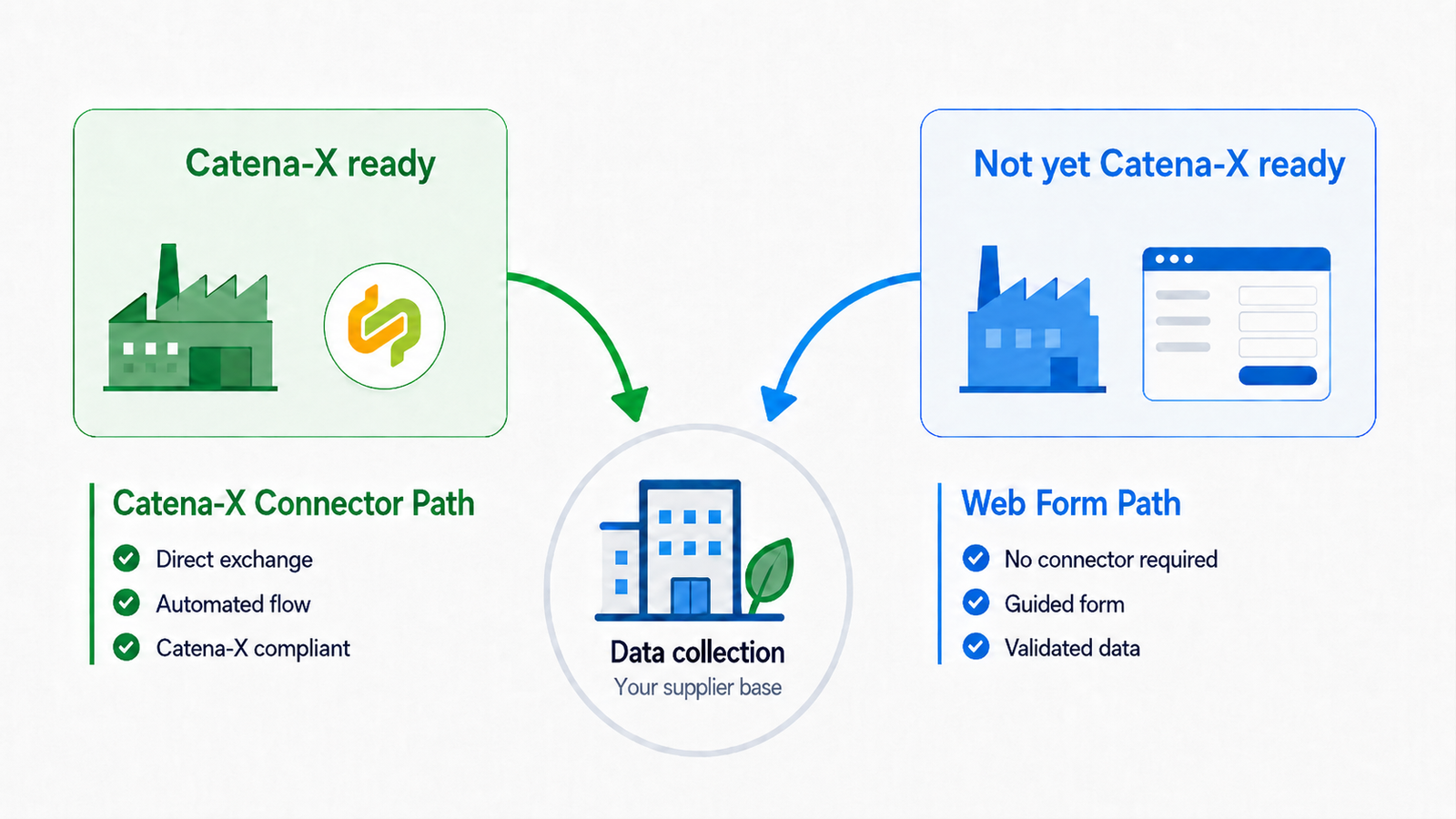
Two paths, one standard. PACIFIC collects compliant PCF data regardless of where your supplier starts.
Path 1: Catena-X Connector (For Tech-Ready Suppliers)
If your supplier already has an Eclipse Data Space Connector (EDC) set up, this is the cleanest option. Data flows directly from their system to yours in Catena-X rulebook-compliant format. No email. No manual entry. No format conversion. Realistically, this applies to 10 to 20% of your supplier base today. The rest need a different path.
Path 2: Supplier Web Form (For Everyone Else)
The majority of Tier 2 and Tier 3 suppliers do not have IT resources to set up a Catena-X connector. Asking them to do so before they can send you data is the reason PCF data collection stalls at the pilot stage. PACIFIC’s web form changes that. A supplier receives a link, fills in their PCF data through a guided form, and submits. No connector setup. No IT department needed. The data is validated against Catena-X rulebook requirements on the way in. What arrives in your system is already structured correctly. To be clear: a supplier does not need to be part of the Catena-X network to use the web form. They receive a link, fill in their PCF data through a guided interface, and submit. PACIFIC handles the formatting and validation on the back end. From the supplier’s side, it is no more complicated than filling in an online form.
🎯 See both paths in action → Book a PACIFIC Demo
What the Catena-X Rulebook Actually Requires
What is the Catena-X PCF Rulebook? The Catena-X PCF Rulebook defines the data model, data quality requirements (DQR), and technical exchange format for product carbon footprint data in the automotive supply chain. It aligns with WBCSD PACT methodology. For your PCF data to be accepted by an OEM through Catena-X, it must comply with this rulebook.
Three key requirements under the Catena-X rulebook:
- Data must follow cradle-to-gate system boundaries for most automotive components
- It must include a Data Quality Rating (DQR) assessing how primary versus estimated the underlying data is
- It must be structured to transmit through a Catena-X-compatible protocol
Spreadsheets cannot produce this. They produce a number — not the structured dataset with the methodology trail the rulebook requires. This is a format problem, not a workflow problem. No process improvement fixes it. 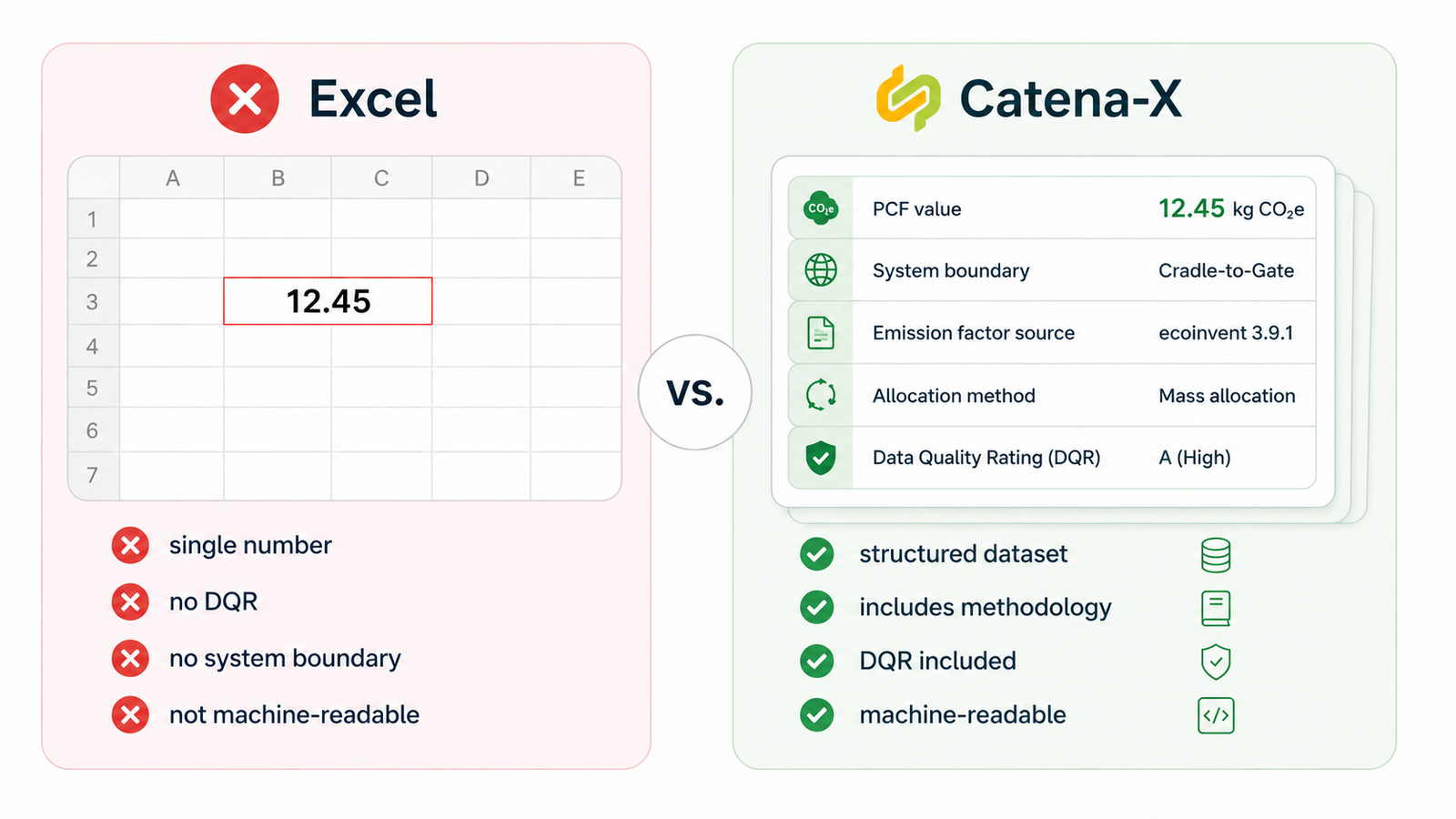
Excel gives you a value. The Catena-X rulebook requires a verified, structured dataset.
How to Collect PCF Data from Suppliers Automatically: 3 Steps
Step 1: Segment your supplier base by digital readiness
Map your active suppliers into two groups: those with existing Catena-X connections and those without. Most supplier bases split roughly 15–20% ready, 80–85% not yet. Time investment: half a day. Quick win: you immediately see where your biggest data gap is.
Step 2: Assign each group to the right collection path
Route tech-ready suppliers to the Catena-X connector. Route everyone else to the web form. The mistake most teams make is forcing all suppliers through the same path. That is why previous collection attempts stall. Time investment: 2 to 4 hours to configure via PACIFIC’s supplier onboarding flow.
Step 3: Validate against the Catena-X rulebook on receipt
Do not wait until you are preparing an OEM submission to find data quality issues. Validate each supplier response as it arrives. Check system boundaries, DQR score, and allocation method before the data enters your reporting workflow. Time investment: automated via PACIFIC’s built-in validation engine.
The Real Question Is Timing
You can keep the spreadsheet process running for another 12 months. But the OEM requests are already arriving. Catena-X is moving from pilot to standard operating procedure faster than most Tier 1 teams anticipated. Two paths. One standard. No spreadsheets.
Key Takeaways
- Spreadsheets produce a number but not Catena-X rulebook-compliant PCF data. The format problem has a hard ceiling no workflow improvement can fix.
- Supplier bases split into two groups: those with Catena-X connectors (15–20%) and everyone else. Both groups need a different collection path.
- The web form is the only practical way to collect Catena-X-standard data from suppliers without EDC connector setup.
🚀 Ready to start? Book a PACIFIC Demo


