



Your OEM customer’s supplier portal flags a new request. Sixteen part numbers, each needing a Product Carbon Footprint, calculated to something called the WBCSD PACT standard, delivered in a format their system can read. Due in three weeks.
You forward it to whoever handles sustainability. Nobody has produced a PACT-conformant footprint before.
This is the reality for suppliers right now. The requests are real, the deadlines are real, and the PACT standard exists because no OEM wants a dozen suppliers sending the same number a dozen different ways.
This guide explains what that request actually means, what PACT requires on both the calculation and the exchange side, and how to respond without building anything from scratch.
What Is the WBCSD PACT Standard?
Definition: WBCSD PACT Standard The global protocol for calculating and exchanging cradle-to-gate Product Carbon Footprints, published by the Partnership for Carbon Transparency under the World Business Council for Sustainable Development. It has two parts: a methodology for how you calculate a PCF, and technical specifications for how you exchange it between IT systems.
Think of it as grammar plus telephone line. The methodology makes sure two companies mean the same thing by “one PCF.” The specifications make sure their software can actually pass that PCF back and forth. You need both. A perfect calculation you can’t share is a dead end, and a clean data pipe carrying inconsistent numbers is worse.
Before the standard, every carmaker asked for emissions data its own way. One wanted a PDF, one wanted a portal login, a third sent a 40-tab Excel template. Supply five OEMs and you filled five different forms for the same part. PACT replaces that with one rule set, built on the WBCSD PACT Methodology, so you calculate a number once and share it in a way every partner can read and trust.
Why the PACT Standard, and Why Now?
Dozens of OEMs and thousands of suppliers now need the same kind of PCF data on different schedules, and spreadsheets don’t scale to that. Every Tier 1 ends up maintaining a different template for every OEM it sells to, and every Tier 2 does the same one level down. The core problem is scale: too many requests, too many formats, no shared way to run them.
The pressure is also regulatory. The CSRD directive pushes Scope 3 transparency down the chain, and OEMs are writing PACT conformance straight into supplier contracts. A carbon number you can’t produce in the right format makes you the weak link in your customer’s reporting. The weak link is the part that gets re-sourced.
Why the Calculation Method Matters for Acceptance
Sending a number isn’t the hard part. Sending one your OEM will accept is. A footprint built from spend-based factors, where you multiply money spent by an industry average, might clear a first review. But it isn’t tied to your actual production, and OEMs are paying closer attention to that every year. Activity-based data, drawn from your real bill of materials and processes, produces a number that holds up when someone checks it. Getting the method right the first time is cheaper than redoing every footprint once a customer pushes back.
What the PACT Methodology Requires
The methodology side sets the calculation rules. PACT Methodology V3, released 30 April 2025, is the version you must use for any new footprint. It builds on the GHG Protocol Product Standard and ISO 14067, then adds the specific choices those standards leave open. Three requirements matter most.
A fixed system boundary. PACT is cradle-to-gate. Every supplier draws the line in the same place, so numbers actually stack up the chain.
Rules for the hard stuff. V3 added real guidance on land sector emissions and removals, on electricity accounting, and on carbon capture and storage. It also extended to service-based businesses for the first time.
Recalculation triggers. A V2 footprint stays valid for three years, but you must recalculate if production changes by more than 10%, or if the product is bio-based with over 5% biogenic carbon content. V2 itself is withdrawn, so anything new follows V3.
What the Technical Specifications Require
The exchange side is where most companies underestimate the work. The Technical Specifications (current version 3.0.3, published November 2025) define a machine-to-machine protocol so any two conformant systems can trade footprints automatically. A calculation sitting in your ERP isn’t PACT data exchange. Sending it through the standard API is.
A PACT conformant host system has to implement a shared data model and a common API, so it can exchange footprints with any other conformant system. In practice that means a standard ProductFootprint data model with defined fields, authenticated requests between the data owner and the data recipient, and a defined endpoint the recipient calls with a footprint’s unique ID to pull the exact PCF it needs. The standard supports both synchronous exchange, where you request a footprint and get it back immediately, and asynchronous exchange, where systems notify each other when new data is ready.
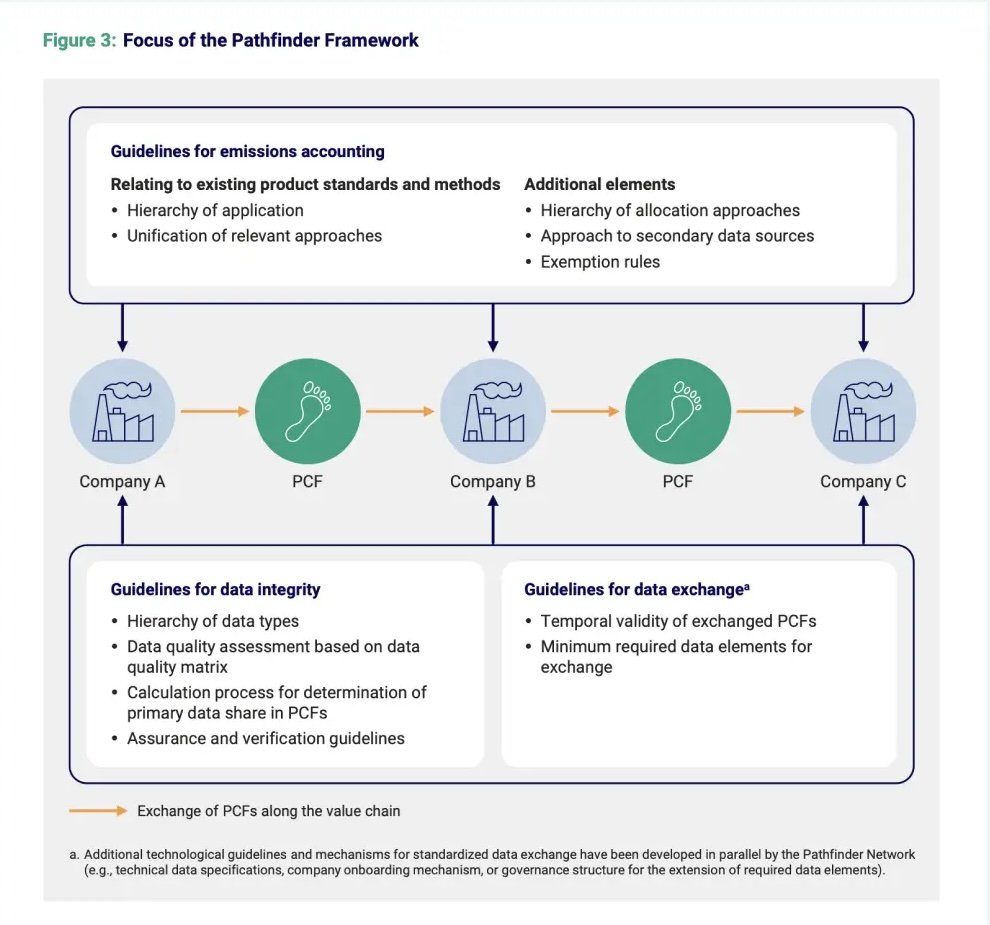
Source: PACT Methodology: Guidance for the Accounting and Exchange of Product Life Cycle Emissions
How CircularTree Can Help
CircularTree covers both halves of the standard, depending on whether you still need to calculate the footprint or already have it and need to send it.
1. CarbonMatch: Calculate a PACT-Conformant Footprint
If the footprint doesn’t exist yet, CarbonMatch handles the calculation side. It matches your bill of materials against emission factor databases so you can see where the carbon is concentrated in a product, instead of starting from a blank spreadsheet, and produces a number aligned to the V3 methodology. Best for: Suppliers who need to calculate a PCF before they have anything to send. → circulartree.com/scope-3-emissions
2. PACIFIC: Exchange It Through the Network
Once the footprint exists, PACIFIC handles the exchange side through a PACT and Catena-X conformant host system, so your OEM receives a rulebook-aligned PCF without you standing up a connector yourself. Best for: Suppliers whose customers are requesting PCF data through Catena-X. → circulartree.com/pacific
How to Respond to a PACT Request
1. Recalculate on V3. Start with the parts your largest customers actually request, not your whole catalogue. With the right tool this is days, not weeks, once your BOM data is in.
2. Get the calculation method right. Build from activity data, not spend-based averages, so the number holds up when the OEM checks it. This is the step people skip and pay for later.
3. Hand off through a conformant host system. Onboarding is the slow part, so start it early and run it in parallel with the calculation work. Your OEM then receives a footprint that’s valid on arrival, with no reformatting on either side.
Two common mistakes worth avoiding: treating the exchange side as an afterthought, when it’s where deals actually stall, and letting a footprint drift past a major process change, which makes it non-conformant even if the number still looks fine.
Frequently Asked Questions
- Is the WBCSD PACT standard mandatory? PACT is a voluntary industry standard, not a law. But it’s increasingly required by contract. OEMs and other large buyers now write PACT conformance into supplier agreements, so for many suppliers it functions as mandatory in practice even though no regulator enforces it directly.
- What’s the difference between the PACT Methodology and the Technical Specifications? The Methodology defines how you calculate a footprint, including system boundary and calculation rules. The Technical Specifications define how you exchange that footprint between IT systems, covering the data model, authentication, and API. You need both to be fully conformant.
- Is a spend-based estimate good enough for an OEM’s request? Sometimes, for a first pass. But OEMs increasingly want activity-based, primary data behind a PCF rather than a generic industry average, because audit expectations keep getting stricter. A spend-based number is the one most likely to come back.
- Do I need special software to meet the PACT standard? In two places. You need a calculation tool that follows the V3 methodology, and a conformant host system to exchange the result. You can’t send conformant data by email or spreadsheet. CarbonMatch covers the calculation and PACIFIC covers the exchange.
Related reading:


