



Your biggest customer just sent an email. They need the product carbon footprint for the part you ship them, in a specific format, through something called Catena-X, by a date that is closer than you’d like. You’ve never heard of half the words in the request. Sound familiar? This is happening to thousands of small and mid-sized suppliers right now. Most of them open a spreadsheet and start panicking. There’s a better way to handle it.
💡 No time to read the whole thing? Check out Our webpage on PACIFIC
- What is Catena-X?
- Why Catena-X matters for SMEs right now
- What Catena-X actually asks an SME to do
- How to get Catena-X ready: 3 steps
- Catena-X vs Cofinity-X
- How long does it take?
- Does it apply to small suppliers?
- What it means for CSRD
- Common mistakes to avoid
- Key takeaways
What is Catena-X?
Definition: Catena-X Catena-X is the open, standardised data ecosystem for the automotive industry. It lets companies along the supply chain, from raw material suppliers to OEMs, exchange data such as product carbon footprints in one trusted, comparable format, instead of dozens of incompatible spreadsheets and email threads.
Think of it as a shared language for supply chain data. Before Catena-X, every carmaker asked for emissions data their own way. One wanted a PDF. Another wanted a portal login. A third sent a 40-tab Excel template. If you supplied five OEMs, you filled out five different forms for the same part.
Catena-X fixes that. It defines one rule set, one exchange standard, and one technical framework, built on the WBCSD PACT Pathfinder Framework. You calculate your number once and share it in a way every partner can read and trust. No more reformatting the same data for every customer who asks.
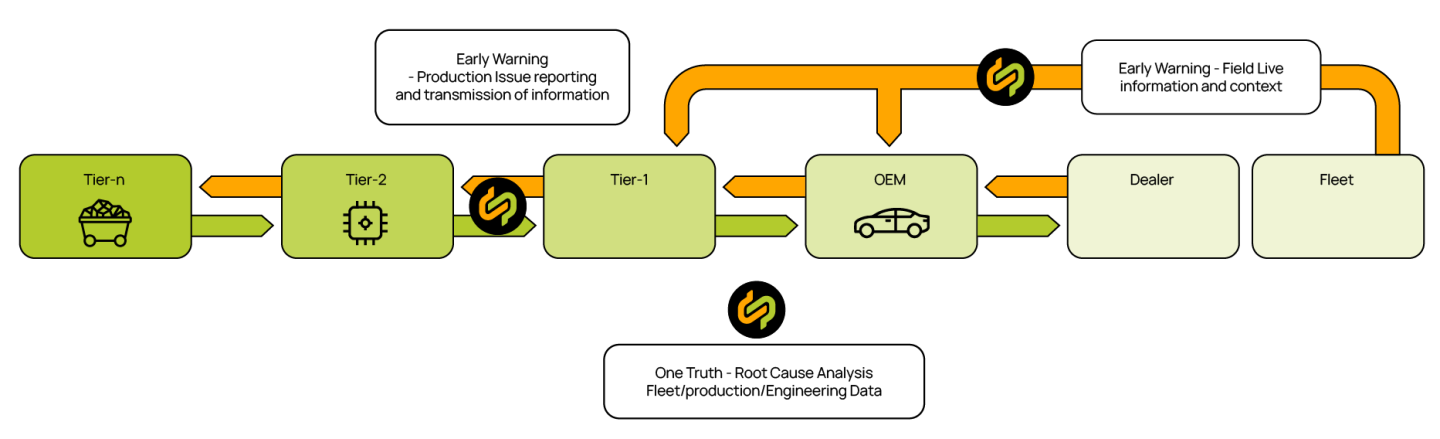
Catena-X for SMEs: data exchange network connecting automotive OEMs and SME suppliers
Why Catena-X matters for SMEs right now
Here’s the part that makes this urgent. It’s shifting from “nice to have” to “required to keep the contract.”
OEMs are already writing Catena-X-based carbon data into supplier requirements. The Catena-X PCF Rulebook now treats two metrics as mandatory after the transition phase, which ends in 2027: the Primary Data Share (how much of your footprint comes from your own real data, not industry averages) and the Data Quality Rating. Both will be required for data exchange across the network. That deadline feels far away. It isn’t, once you account for how long supplier onboarding actually takes.
For an SME, the risk isn’t abstract. If you can’t deliver a credible carbon footprint in the format your customer needs, you become the weak link in their reporting. And the weak link is the part that gets re-sourced.
Definition: Primary Data Share The Primary Data Share is the percentage of a product carbon footprint built from a company’s own measured data rather than generic database averages. A higher share means a more accurate, more defensible number. Under the Rulebook, it becomes a mandatory metric after the transition phase ending in 2027.
There’s an upside that often gets missed. Germany’s Federal Ministry for Economic Affairs and Energy is funding a €23 million Data Space Accelerator aimed squarely at getting SMEs into the ecosystem. Qualifying companies can receive up to €30,000, roughly €15,000 for onboarding and certificate management, and another €15,000 for a second use case such as product carbon footprint. The money to start is, for once, partly on the table.
What Catena-X actually asks an SME to do
Strip away the jargon and the ask is narrow. You need to do three things well.
First, you need a product carbon footprint for the parts your customer cares about. The standard follows a cradle-to-gate boundary, which means you count emissions from raw material extraction up to the moment the part leaves your factory. The use phase and end-of-life are excluded. That keeps the scope smaller than people fear.
Second, you need that footprint in the Catena-X format, both machine-readable (JSON) and human-readable (PDF). This is the standardisation piece. It’s also where most manual approaches fall apart.
Third, you need a way into the network. Cofinity-X is the operational marketplace that onboards companies and validates them, after which you use apps from its marketplace to handle the actual data exchange. You don’t build the plumbing yourself. You plug into it.
That’s the whole job. A footprint, in the right format, exchanged through the right channel. The hard part is doing it without hiring a sustainability team you don’t have.
🎯 Want to see Catena-X exchange working on a real part, end to end? Book a 20-minute PACIFIC demo →
How to get Catena-X ready: 3 steps
You don’t need to boil the ocean. You need a footprint your customer accepts and a pipe to send it through. Here’s the order that works.
Step 1: Calculate the PCF for your priority parts
- Tool: a Catena-X-aligned PCF calculator such as PACIFIC
- Time investment: a few days for your first parts, not weeks
- Quick win: a defensible number, with the data quality flags Catena-X expects
Start with the parts your largest customers actually request. Don’t try to footprint your entire catalogue on day one.
Step 2: Get the format and data quality right
- Tool: PACIFIC, the Catena-X-certified PCF management and exchange solution by BASF, built on CircularTree technology
- Time investment: setup, then minutes per PCF
- Quick win: machine-readable JSON and a human-readable PDF, produced automatically
This is where the Primary Data Share and Data Quality Rating get attached correctly. Getting these wrong now means redoing the work in 2027.
Step 3: Onboard and exchange through Catena-X
- Tool: Cofinity-X for network entry, then a certified exchange app
- Time investment: the validation step is the slow part, so start it early
- Quick win: your customer receives a trusted PCF in their system, no reformatting on either side
Over 100 automotive suppliers already run this path through PACIFIC. One mid-sized supplier reported PCF calculations running three to five times faster than their manual method, saving more than €10,000 per calculation. The tooling pays for itself when the alternative is a person with a spreadsheet and a deadline.
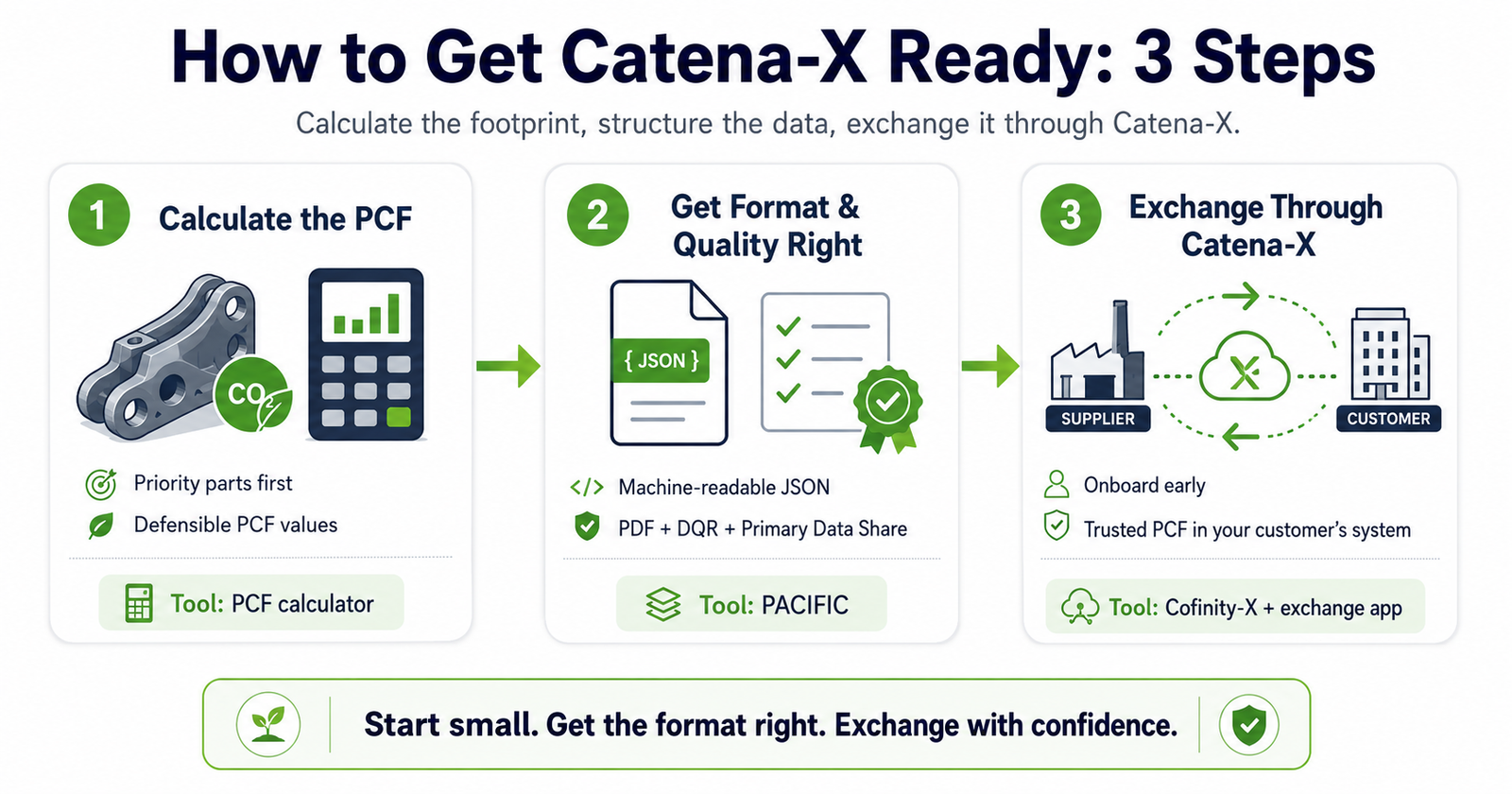
Three steps to get Catena-X ready for SMEs: calculate PCF, format data, exchange via Cofinity-X
What is the difference between Catena-X and Cofinity-X?
Catena-X is the standard. Cofinity-X is one of the operators that runs it. Catena-X defines the rules, formats, and certification for how data moves. Cofinity-X gives you the practical door into the network: onboarding, validation, and a marketplace of apps that do the actual exchange. You comply with Catena-X by working through an operator like Cofinity-X.
People mix these two up constantly, and the confusion costs time. When an OEM says “send it via Catena-X,” what they mean in practice is “get onboarded through an operator and exchange the data in the certified format.” You don’t choose between them. You use both: the standard tells you what good looks like, the operator gets you connected.
How long does it take to get Catena-X ready?
For a focused SME, first-part readiness takes a few weeks, not months. The PCF calculation for your priority parts takes a few days with the right tool. Formatting and data quality tagging is fast once your data is in. The slow step is network onboarding and validation, which is why you start that early and run it in parallel with the calculation work.
The companies that miss deadlines aren’t the ones with hard data problems. They’re the ones who treated Catena-X onboarding as a final formality and left it to the last fortnight. Validation has its own queue. Respect it, start it first, and the rest moves quickly.
Does Catena-X apply to small suppliers, or just the big players?
It applies to you the moment a customer in the network asks for your data, and that is exactly what’s happening to Tier 2 and Tier 3 suppliers now. The whole point of the model is that primary data flows up the chain, supplier to supplier, until it reaches the carmaker. A Tier 2 supplier sends real PCF data to a Tier 1, who folds it into their own number and passes an accurate value to the OEM. If you sit anywhere in an automotive supply chain, you’re in scope.
Size is not an exemption. It’s the reason the funding exists. The €23 million accelerator was built specifically because regulators know SMEs are the part of the chain most likely to stall, and a stalled supplier is a reporting gap for everyone above them.
What does Catena-X mean for CSRD and wider reporting?
The work isn’t single-use. The same primary carbon data that satisfies a Catena-X request feeds straight into broader sustainability reporting, including the Corporate Sustainability Reporting Directive. Building your data this way now means you’re not starting from zero when the next regulation lands.
That’s the quiet argument for doing this properly rather than minimally. A footprint built on real activity data, with a solid Primary Data Share, is an asset you reuse across customers and across reporting frameworks. A footprint hacked together to clear one OEM’s inbox is work you’ll redo. Build once, use everywhere.
Common mistakes to avoid
A few traps catch SMEs over and over.
- Mistake: leaning on spend-based or generic average emission factors. Fix: build the footprint from activity data so your Primary Data Share holds up.
- Mistake: treating onboarding as a one-week task. Fix: start Cofinity-X validation months before your customer’s deadline.
- Waiting for the OEM to tell you exactly what to do. By the time the formal request lands, you’re already behind.
The suppliers who struggle most are the ones who treat this as a compliance chore to delay. The ones who win treat it as a sales asset. A clean Catena-X PCF is something you can show the next OEM before they even ask.
Key takeaways
- Catena-X is the automotive industry’s shared standard for exchanging supply chain data, including product carbon footprints, in one trusted format.
- For SMEs it’s becoming a condition of doing business, with mandatory data-quality metrics arriving after the 2027 transition and €30,000 in remuneration available to get started.
- You need three things: a credible PCF, the right format, and network access through Cofinity-X. Tools like PACIFIC handle all three so you don’t build it from scratch.
Get ahead of the request instead of scrambling after it. That’s the difference between keeping the contract and explaining why you can’t.
Related reading:
Sources: Catena-X PCF use case, €23M Data Space Accelerator, Cofinity-X.


