



PCF vs CCF isn’t just terminology. It’s the difference between the number your OEM will accept and the number that gets rejected.
Monday morning, an email from your OEM customer lands. They need PCF data for 47 components by Friday. You already file a corporate carbon footprint every year under CSRD. So why does this feel like starting from zero?
It’s because PCF and CCF measure two different things, and the automotive supply chain sits right where both are required at once. Get the distinction wrong and you’ll hand your OEM a number that doesn’t survive their audit, or spend six weeks rebuilding data you already had.
This guide explains the difference, why it matters under CSRD, and how to get from one to the other without doubling your work.
PCF vs CCF: What’s the Actual Difference?
Definition: Corporate Carbon Footprint (CCF) A CCF totals a company’s Scope 1, 2, and 3 emissions across its entire operation for one reporting year, following the GHG Protocol Corporate Standard or ISO 14064. It answers one question: how much does the whole business emit.
Definition: Product Carbon Footprint (PCF) A PCF totals the emissions tied to a single product’s life cycle, from raw material through to delivery at the factory gate in a cradle-to-gate scope, following ISO 14067 or the GHG Protocol Product Standard. It answers a narrower question: how much does this one part emit.
Think of it as zoom level, not two different subjects. The two share Scope 1 and 2 emissions, mostly. But a CCF spreads that operational total across everything a plant produces, while a PCF has to isolate what one specific component actually consumed: materials, machine time, energy draw, transport.
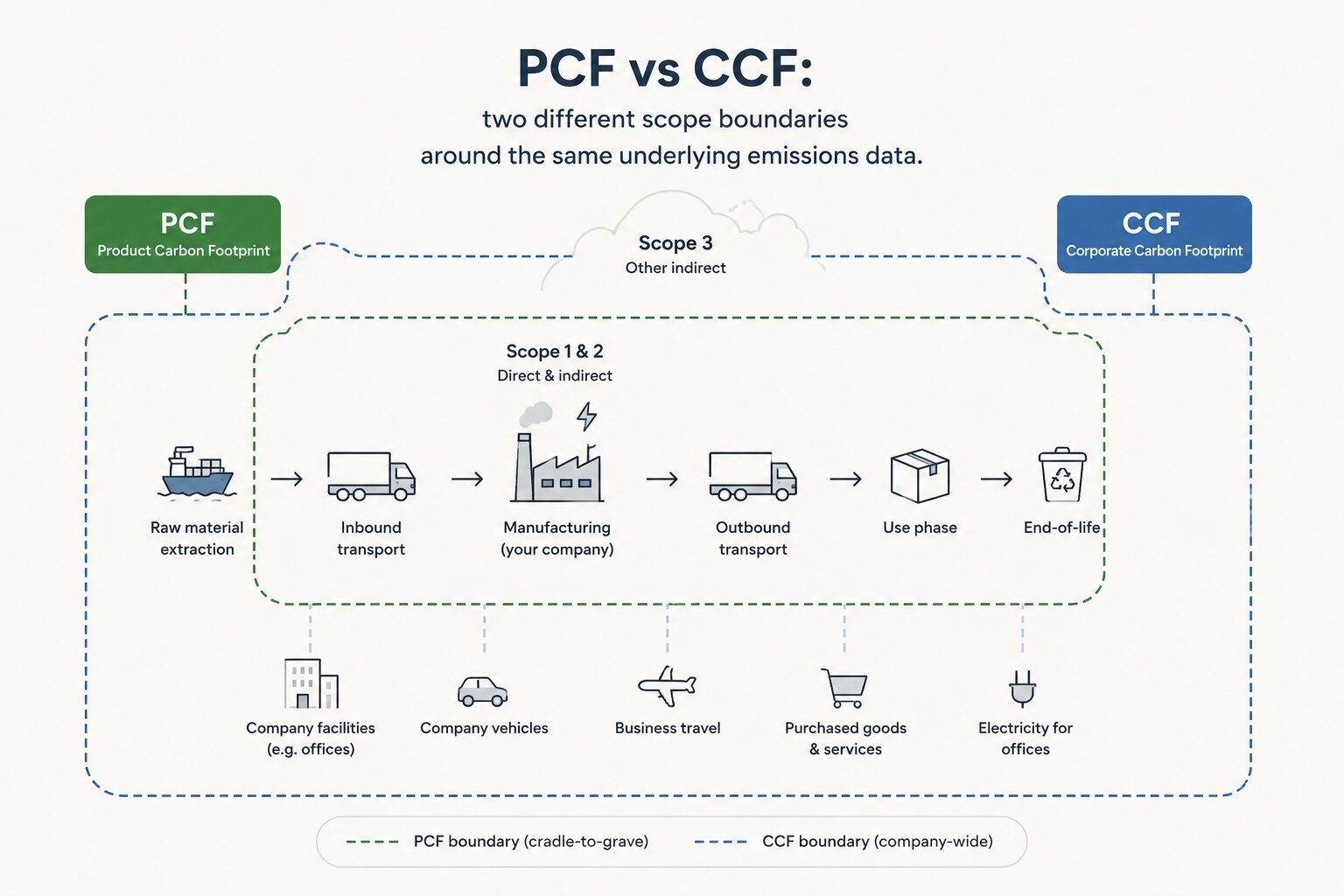
PCF vs CCF: two different scope boundaries drawn around the same underlying emissions data.
Why You Can’t Derive One From the Other
This is where most teams get stuck. Averaging your CCF across production volume gives you a number.
Not an accurate one. A steel bracket and a wiring harness pull very different amounts of energy and material through the same plant, and spend-based allocation flattens that difference. Flattened data doesn’t survive a buyer’s audit.
What works is building the PCF bottom-up: mapping each bill-of-materials line to a verified emission factor, then summing them. That’s activity-based, not spend-based, and it’s the direction CSRD, ISSB, and the GHG Protocol are all moving.
Why the Gap Matters Right Now
Under CSRD, the PCF vs CCF gap is getting harder to hide. Your customer’s Scope 3 Category 1 disclosure is only as good as the product-level data you send them, and OEMs know it. Automotive buyers are pushing PCF requests further down the supply chain in 2026 as their own reporting deadlines close in. “We don’t track it that granularly yet” isn’t an answer that keeps a contract anymore.
Get PCF vs CCF wrong and the cost shows up twice. Rework, when your first PCF submission gets rejected. And risk, when a customer decides a supplier who can’t produce clean product-level data is a supplier worth replacing.
How CircularTree Can Help
CircularTree covers both the calculation and the exchange side, depending on whether you already have the Scope 3 data or still need to build it.
1. CarbonMatch: Build the Scope 3 Data Both Footprints Need
If the component-level data doesn’t exist yet, CarbonMatch handles the calculation side. Instead of your team manually searching Ecoinvent for the right emission factor across, say, 86 components in a seat assembly, seat foams, wiring harnesses, PBT connector housings, CarbonMatch’s AI matches each BOM line to the closest verified LCA dataset automatically. It ranks up to five options per component, so your engineers review and pick instead of searching from scratch.
The output is Scope 3 emission data at the component level, which becomes the core of your PCF and rolls up into a more accurate CCF Scope 3 Category 1 figure.
Best for: Suppliers who need to calculate Scope 3 emissions from a BOM before they have anything to send an OEM. → circulartree.com/carbonmatch
2. Expert Service: Let Our Team Calculate It for You
If you don’t have anyone in-house to run the BOM matching yourself, CircularTree’s team can do it for you. Send us your bill of materials and we handle the emission factor matching, review the output, and deliver a finished, audit-ready PCF and CCF Scope 3 figure, no software rollout required on your end.
Best for: Suppliers without the in-house bandwidth or expertise to run CarbonMatch themselves who’d rather hand off the calculation entirely. → Talk to our team
3. PACIFIC: Exchange the PCF With Your OEM
Once the footprint exists, PACIFIC handles the exchange side through a PACT and Catena-X conformant host system, so your OEM receives a rulebook-aligned PCF without you standing up a connector yourself.
Best for: Suppliers whose customers are requesting PCF data through Catena-X. → circulartree.com/pacific
PCF vs CCF: How to Get From One to the Other
1. Map your BOM to emission factors. Use the CarbonMatch BOM uploader. Two to three hours for a first product line, with an instant view of which components drive most of the footprint.
2. Separate cradle-to-gate PCF from full CCF. Run a CarbonMatch export alongside your existing CSRD workflow. Half a day to reconcile scope boundaries, and one dataset now feeds two reports instead of two separate builds.
3. Assemble OEM-ready PCF documentation. Drop CarbonMatch’s Scope 3 emission data into your PCF documentation template, or send it directly through PACIFIC. Same-day turnaround, and fewer back-and-forth questions from procurement on methodology.
Two common mistakes worth avoiding: using spend-based averages for product-level claims instead of activity-based BOM matching, and treating CCF and PCF as one calculation rather than two scope boundaries sharing the same underlying component data.
Frequently Asked Questions
- What’s the difference between CCF and PCF? A CCF covers a company’s total Scope 1, 2, and 3 emissions for one reporting year. A PCF covers one product’s emissions across its life cycle, typically cradle-to-gate. They share some underlying data but answer different questions.
- How is each one calculated? A CCF follows the GHG Protocol Corporate Standard or ISO 14064. A PCF follows ISO 14067 or the GHG Protocol Product Standard, built bottom-up from bill-of-materials data matched to verified emission factors.
- Do automotive suppliers need both? Yes. CSRD requires your own corporate footprint, and OEMs increasingly require product-level PCF data for their Scope 3 Category 1 reporting. One doesn’t substitute for the other.
- How does a PCF feed into CSRD Scope 3 reporting? Your PCF is your customer’s Scope 3 Category 1 input. The same component-level Scope 3 data that builds your PCF also strengthens your own CCF’s Scope 3 figure, instead of running two disconnected data-gathering exercises.
Related reading:


