



How to calculate the carbon footprint of a product comes down to one repeatable formula: activity times emission factor, added up across the bill of materials. You’ll find it phrased almost exactly that way on the first page of any search result.
What those results don’t show is where the formula breaks down once you’re staring at an 86-line bill of materials and a Catena-X deadline.
This guide explains what the four steps actually involve, what PACT and the Catena-X Rulebook expect you to prove at each one, and how to produce a submission-ready number without building anything from scratch.
What Does It Mean to Calculate the Carbon Footprint of a Product?
Definition: Product Carbon Footprint Calculation The process of quantifying the cradle-to-gate greenhouse gas emissions of one unit of product, by matching every line of its bill of materials to an emission factor, then scoring the result for data quality under standards like the WBCSD PACT Methodology and the Catena-X PCF Rulebook.
Think of it as a recipe plus a receipt. The recipe is the four-step method: everyone measures the same boundary, builds the same kind of inventory, and matches to the same factor databases, so two companies mean the same thing by “one PCF.”
The receipt is the data quality score attached to it, proof of where the numbers actually came from. A perfect calculation with no receipt behind it is a number nobody can audit, and a data quality score with no consistent method behind it is worse.
Before the PACT Methodology and the Catena-X Rulebook existed, every OEM scored this differently. One wanted a spreadsheet with their own emission factors baked in, one wanted a consultant’s LCA report, a third just wanted a single number with no method disclosed. Supply five OEMs and you were solving the same calculation five different ways.
The WBCSD PACT Methodology and its automotive-specific extension, the Catena-X PCF Rulebook, replace that with one calculation method, so you run the numbers once and the result holds up no matter who’s asking.
Why This Is Getting Harder, Not Easier
Dozens of OEMs and thousands of suppliers now need PCF data on their own schedules, and a spreadsheet built for one customer’s template doesn’t survive contact with the next one. A Tier 1 supplier we work with went from three PCF requests a year in 2023 to over sixty in 2026, each with its own deadline and its own data quality expectations.
The pressure compounds from regulation too. The CSRD directive pushes Scope 3 transparency down the supply chain, and the Catena-X Rulebook keeps moving underneath suppliers who thought they were done. Version 4 landed in September 2025 with new rules for biogenic carbon and electricity accounting. Version 4.1 lands in Q3 2026 with further refinements. A PCF calculated under the old rulebook may now need parts of it redone.
Do the calculation wrong, or in a format the network doesn’t recognize, and it’s worse than doing nothing. A technically accurate PCF with the wrong data model or a missing DQR score gets bounced back. That’s weeks lost, with your customer watching.
Why the Calculation Method Matters for Acceptance
Sending a number isn’t the hard part. Sending a number your OEM will keep is. A footprint priced off spend, dollars multiplied by an industry-average factor, can pass a first read. It just doesn’t map to anything you actually made, and reviewers are getting sharper about spotting that.
Match against real activity data, your actual materials and processes, and the number survives a second look. Doing that from the start costs less than redoing every submission after a customer sends it back.
How to Calculate the Carbon Footprint of a Product: Steps 1 and 2
The number itself comes together in four steps. The first two are about the calculation.
Step 1: Set your boundary and functional unit. Cradle-to-gate is the default for intermediate goods sold B2B, covering everything from raw material extraction to your factory gate. Set a functional unit too, one connector housing, one kilogram of finished part, so every number downstream has something consistent to compare against.
Step 2: Build the bill of materials inventory. Your bill of materials lists every material and component with quantities. A mid-complexity automotive part runs 40 to 90 line items. Roughly three-quarters of a typical Tier 1 supplier’s footprint comes from materials, so that’s where the data-collection effort belongs first, not logistics or packaging.
What Getting It Accepted Requires (Steps 3 and 4)
The last two steps decide whether that number survives a Catena-X submission.
Step 3: Match emission factors line by line. Each BOM line needs an activity-based factor, a coefficient that converts a unit of material or energy into kilograms of CO₂ equivalent. Ecoinvent is the standard reference, with over 250,000 entries, and it’s what most PACT-aligned tools draw from. The work isn’t the multiplication, it’s catching the aluminum alloy that isn’t quite the generic “aluminum, primary” entry.
Step 4: Calculate, score, and verify. Sum the line items into a total, then check that the biggest emission source matches what you’d expect from the product’s composition. This is also where DQR, Data Quality Rating, comes in.
PACT and the Catena-X Rulebook both require you to score how good your underlying data actually is, not just report a number. A PCF built entirely on generic database averages scores worse than one with primary supplier data on the top emission sources, and OEMs are starting to reject submissions that don’t clear the threshold regardless of the CO₂e figure itself.
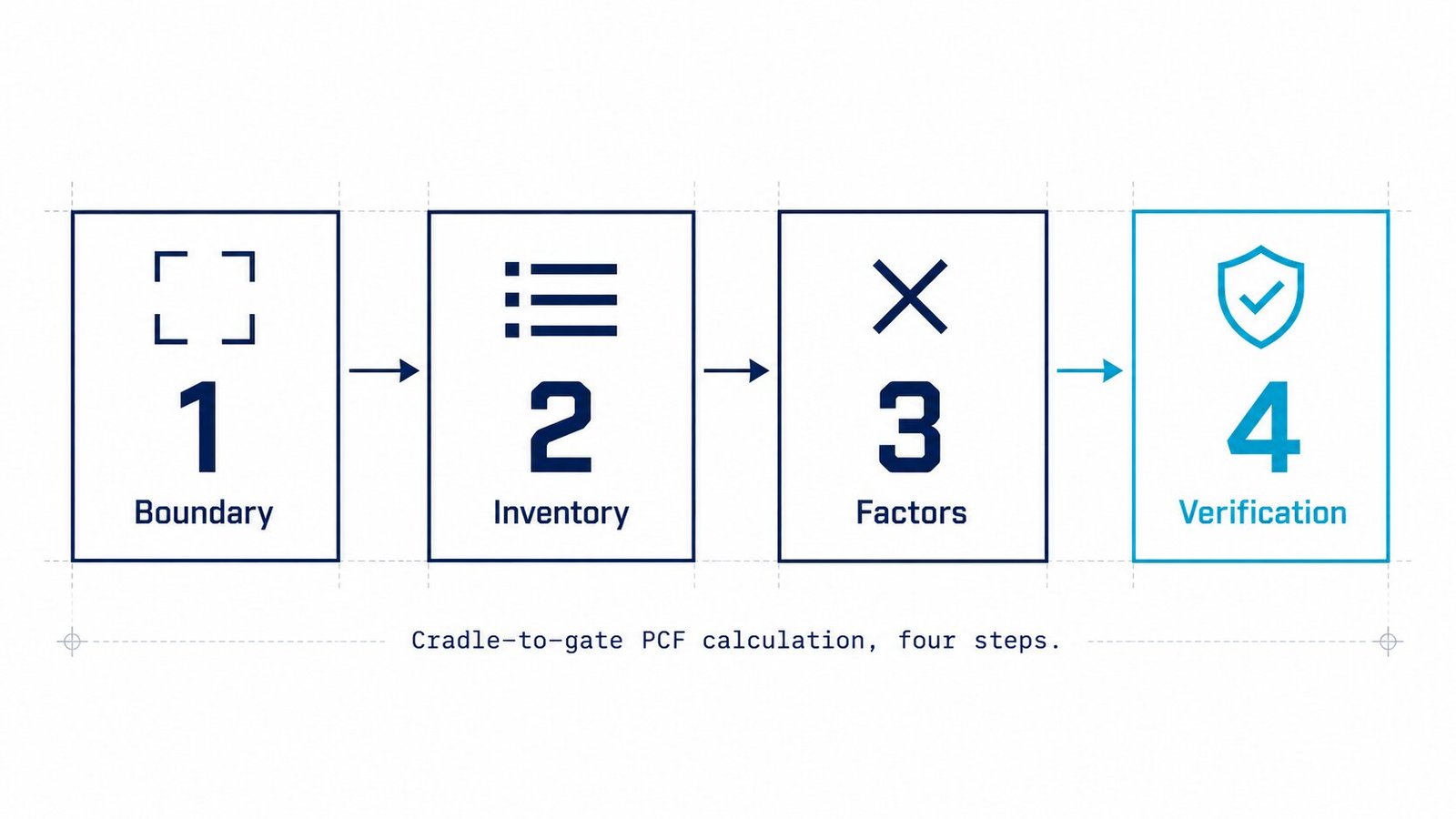
The four steps a product carbon footprint calculation passes through before it’s ready for Catena-X or PACT submission.
How CircularTree Can Help
CircularTree covers both halves, depending on whether you still need to calculate the footprint or already have it and need to send it.
1. CarbonMatch: Calculate a PACT-Conformant Footprint
If the footprint doesn’t exist yet, CarbonMatch handles the calculation side. It matches your bill of materials against emission factor databases so you can see where the carbon is concentrated in a product, instead of starting from a blank spreadsheet, and produces a number aligned to the current PACT methodology. Best for: Suppliers who need to calculate a PCF before they have anything to send. → circulartree.com/scope-3-emissions
2. PACIFIC: Exchange It Through the Network
Once the footprint exists, PACIFIC handles the exchange side through a PACT and Catena-X conformant host system, so your OEM receives a rulebook-aligned PCF without you standing up a connector yourself. Best for: Suppliers whose customers are requesting PCF data through Catena-X. → circulartree.com/pacific
How to Produce Your First Submission-Ready PCF
1. Set the boundary and build the BOM first. Start with the products your largest customers actually request, not your whole catalogue. With the right tool this is hours, not weeks, once your bill of materials is in a usable format.
2. Put real data on your top emission sources. Primary supplier data on the top five to eight materials moves your DQR score more than chasing precision everywhere else. This is the step people skip and pay for later.
3. Export through a conformant system, not a spreadsheet. Onboarding to a PACT or Catena-X conformant host takes time, so start it while the calculation is still running. Your OEM then receives a footprint that’s valid on arrival, with nothing to reformat on either side.
Two mistakes worth avoiding: pricing your footprint off spend instead of activity data, and letting a PCF drift past a major production change, which makes it non-conformant even if the number still looks fine.
Frequently Asked Questions
- What data do I need to calculate a product carbon footprint? A structured bill of materials with quantities, plus emission factors for each material and process. Primary data from your own operations and key suppliers improves your DQR score. Everything else can run on verified database factors like ecoinvent.
- What’s the difference between cradle-to-gate and cradle-to-grave? Cradle-to-gate stops at your factory gate and excludes use phase and disposal. Cradle-to-grave covers the full lifecycle through end of life. Most B2B automotive components use cradle-to-gate because the supplier only controls emissions up to that point.
- Is a spend-based estimate good enough for an OEM’s request? Sometimes, for a first pass. But OEMs increasingly want activity-based, primary data behind a PCF rather than a generic industry average, and a spend-based number is the one most likely to come back for revision.
- How accurate does a PCF need to be for Catena-X submission? Accuracy alone isn’t the bar. Catena-X and PACT also score data quality through DQR. A PCF with strong primary data on its top emission sources clears review even with some uncertainty in the total; one built entirely on generic averages may not.
Related reading:


